
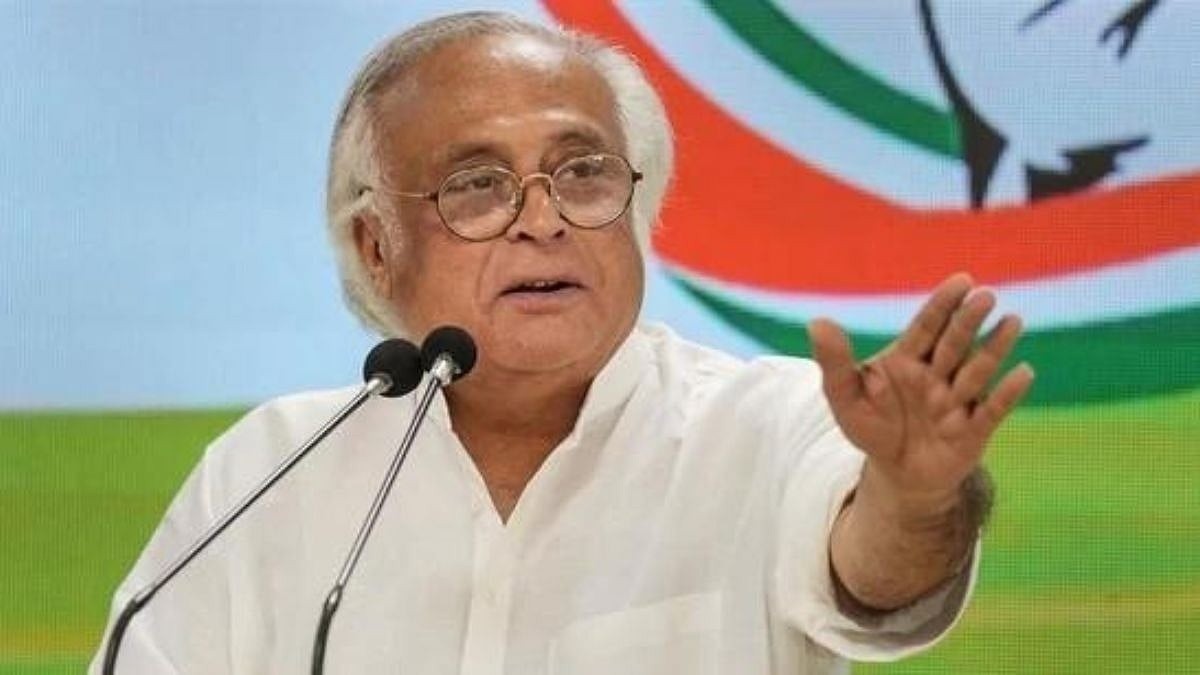
From
a room in a South Avenue flat, less secret but as dingy as a World War
operations room, Salman Khurshid, Jairam Ramesh and Co. charted out the
Congress strategy for the 2004 elections. After the victory, Ramesh was
called out to draft the Common Minimum Programme, in which he once again
proved that if politics is the art of the possible, so is its economics.
Excerpts from an interview, in which he gives his views on the Left’s
diktats, on Amar Singh’s pin-pricks, on the Congress’s new
experiment with dual centres of power. Jairam spoke to R. Pasanna
RP:
The Congress victory came as a surprise to the media
as well as the political circles. Was the party expecting it?
JR: The
victory was a surprise; our performance was not. By the second week of
February we were expecting 135 to 145 seats. But we didn’t expect
to be the single largest party or to form the government. I think we had
overestimated the Vajpayee factor.But
I am not very happy with our performance. We had a disaster in Kerala;
Karnataka was bad, Orissa a disaster…. In Maharashtra we could have
done better, had the RPI [Republican Party of India] not split. Punjab
was very bad.
RP:
What was the reason for the debacle in states such
as Kerala, where the party has been in power
JR:
In
Kerala it had nothing to do with anti-incumbency or the CPI(M)’s
popularity. It was plain and simple disgust of the people with the perennial
infighting in the Congress. The sooner we read the signals, the better
for us.
RP:
Now you will have to fight the Left in Kerala and
West Bengal, while depending on their support at the Centre.
JR:
Some amount of contradiction
is inevitable. Hinduism is an attempt at managing contradictions. I always
believe that being a Hindu gives me the ability to reconcile opposites,
much better than anybody else. Yes, it is a bit of a tension. But we (the
Congress and the Left) share a common hatred for the BJP. Broadly, both
of us are left-of-the-centre parties.
RP:
Haven’t you forgotten other left-of-the-centre
secular parties, such as Mulayam Singh’s Samajwadi Party?
JR:
Our
problem is not with Mulayam Singh; our problem is with Amar Singh. This
constant pin-pricking from Amar Singh… Mulayam is political. You can
fight him politically. We are after all going after the same secular space,
although the OBCs have never voted Congress earlier. There is a wealth
of evidence to show that many Samajwadis preferred the BJP to the Congress.
The links that Amar Singh has with BJP leaders such as Arun Jaitley are
well known.We
tried for an alliance with the BSP; it didn’t work. Now Ajit Singh
(of RLD) wants to have an alliance with us. Another five years and we
will emerge as a formidable force in UP.
RP:
There is a perception that the Common Minimum Programme
has been dictated by the Left.
JR:
No.
The CMP is 90 to 95 per cent Congress manifesto. There are only two or
three elements where the Left parties expressed views and I personally
was in sympathy with those views. And I incorporated them. We listened
to all our allies—to Laloo Prasad Yadav, to Ram Vilas Paswan, to
the Left. If we are running an alliance, we can’t ride roughshod
over their concerns. We can’t say, help us to fight the BJP, but
we won’t listen to you.
RP:
But the stock market reacted negatively..
JR:
I don’t judge anything in India by the stock market. Stock market
is a stupid instrument. It is prone to wild fluctuations—to both
the positive and the negative side. You can’t use the Sensex as
a referendum on govern-ment’s policies. Economic policies can’t
be reduced to a one-day match. The
CMP reflects the agenda for the next five years, with a strong focus on
farmers, workers, weavers, etc. The vote in Tamil Nadu, in Andhra Pradesh,
in Haryana, in Karnataka was protest vote by farmers. They had not been
heard through these reforms.
RP:
Was it the failure of the NDA government?
JR:
It was the failure
of all the governments in the last 13-14 years. That we have given an
elitist approach to reforms. It is the failure of the Congress from 1991
to 1996, of the United Front from 1996 to 1998, and the NDA that reforms
have not been part of mass politics.
RP:
Now playing mass politics, you also have to carry
the burden. The NDA is going to target the so-called tainted ministers.
JR:
It is a case
of the pot calling the kettle black, if it is all about charge-sheeted
ministers. Unless convicted why should they pay the penalty? Just because
the opposition has no other issue they caught on to this. The ground has
been cut from under them because of Mrs Gandhi’s decision.
RP:
What made her take that decision? Was it the threat
from the Sangh parivar?
JR:
No, all along
she has been saying that she is in politics to bring the Congress back
in power; that her priority is not to become Prime Minister. For six years
she has been saying this. And I suspect that in 1999 when she was criticised
for the 272 statement, she was not thinking of becoming Prime Minister.
RP:
What will be her role in the government and the
party?
JR:
We have a powerful
Congress president and a competent, able Prime Minister. This is a new
experiment. This will be good for the party. Mrs Gandhi will be available
full time for the party. We have many Assembly elections coming up, and
we have organisational challenges in those states where we have not done
well.
RP:
By tradition, the Congress has abhorred dual centres
of power.
JR:
There is no alternative.
There will be a lot of people trying to create misunderstanding between
the party president and the Prime Minister. But they have a perfect relationship
with each other. Contrary to what many people are saying, the Congress
president calls on the Prime Minister every Saturday. They have institutionalised
it.
RP:
All these years, even during the Congress days or
NDA government, we have had a strong PMO (Prime Minister’s Office)
which overrode the ministries. It brought cohesion to government. Hasn’t
it weakened?
JR:
No, it all depends
on the Prime Minister. He is the first among equals. Dr Manmohan Singh
by temperament is a cautious man, a consensus man. He is not a bulldozer.
The PMO will have to be a facilitator, an accelerator. It cannot be a
big brother. It cannot be a superministry.
RP:
We have heard statements on various issues, especially
foreign policy, from various ministries. This gives an impression of lack
of coordination.
JR:
You have been
out of power for eight years, and in the first month every minister is
relishing the prospect of giving an interview. Every minister is swept
off his feet by TV cameras and the print media. In the first month you
know they are engaging in a lot of loud thinking. But things will settle
down.
RP:
Who will bring this coherence? The PM or the Congress
president.
JR:
The Prime Minister
in the government. The Congress president is the chairman of the UPA [United
Progressive Alliance]. To that extent, her responsibility is to ensure
that all allies are singing in the same raga and the same taal. What that
raga and what that taal have been decided in the CMP. So you have two
conductors. Dr Manmohan Singh is conducting the business of government.
Mrs Gandhi is conducting the business of the Congress and the UPA.
RP:
What time do you give the government?
JR:
See, if the Left
parties are responsible—and I believe they are—and the regional
parties—they, too are —there is no reason why this government
won’t last five years. Parties in government are more responsible,
by definition, than those outside it. So I pleaded with my friends in
the Left to join the government. They have their own compulsions. But
I hope that at some stage all the Left parties will join the government.
(Originally
appeared in The Week)
Copyright The Week. All Rights Reserved.