
With
campaigning for the first phase of the Lok Sabha election in its last
week now, Congress and Bharatiya Janata Party strategists are holding
marathon sessions in the capital daily, assessing the gains and pitfalls
of their methods. At
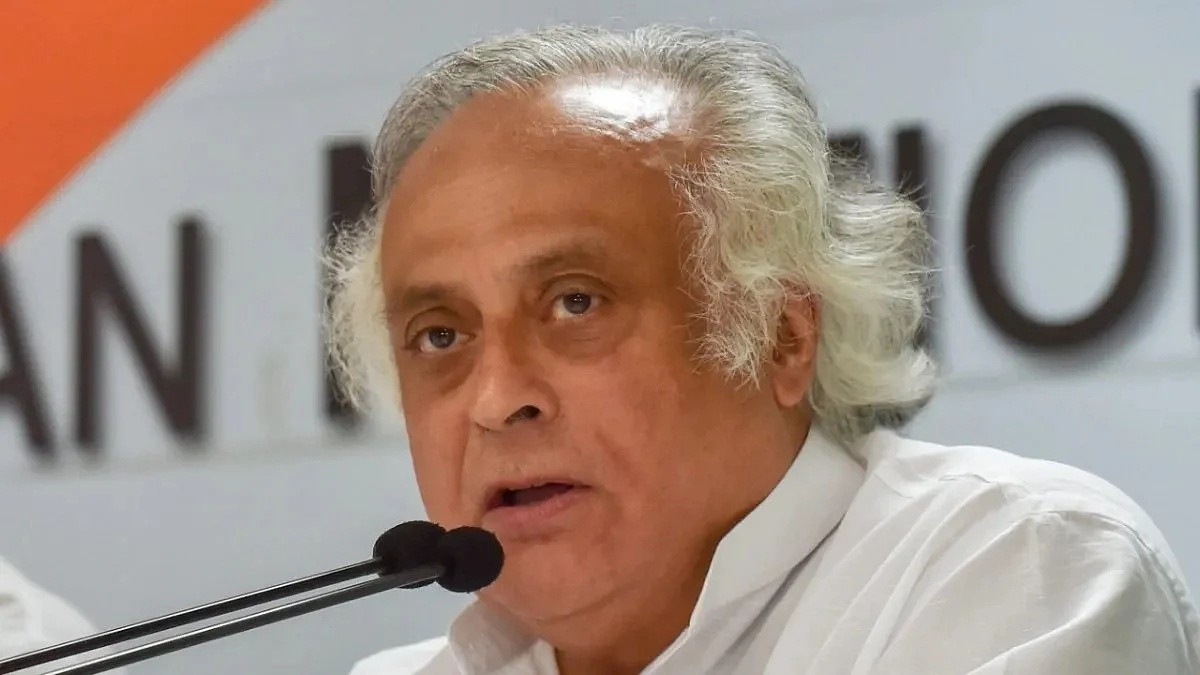
99 South Avenue, Jairam Ramesh, one of the key strategists
of the Congress party’s countrywide campaign, sits glued to his laptop.
“Just wait for the results,” he tells you. “The BJP will
be in for a shock.” In an exclusive interview with Deputy Managing
Editor George Iype, Ramesh, who is also secretary of
the Congress economic wing, discussed his party’s strategy.
GI: Is the mood
in the Congress despondent as the poll dates come closer?
JR: Despondent? Why should the Congress
be despondent? In fact, we are jubilant these days. The latest opinion
poll results say the Congress and its allies have an edge over the BJP
and its partners.
GI:
How many seats does the Congress expect to get?
JR: The Congress alone will get
more seats than the combined ages of Atal Bihari Vajpayee (79) and L
K Advani (77).
GI: Don’t
you think the National Democratic Alliance has an advantage in the election
campaign?
JR: I
don’t think so. I think most opinion polls are showing a close contest
between the NDA and the Congress-led alliance. By and large the strength
of the NDA and the non-NDA forces are almost on par with each other.
I think the NDA does not have an overwhelming advantage of the type
that is being projected in the media. I certainly feel that the Congress-led
campaign has been very effective in all respects. Just wait and see.
When the results are out, the NDA will be in for an unpleasant, shocking
surprise.
GI: Shocking?
JR: Yes, the NDA is going to take
a severe beating despite the so-called India Shining being projected
in the media. You know, if you hear Mr Venkaiah Naidu and other BJP
leaders speak, it looks as if there is an NDA juggernaut that is rolling
across the country. But that is just not true.
GI: Isn’t
India shining, according to you?
JR:I
would not say that India is not shining. There are large parts of Indian
industry that are doing very well, the software industry is doing well,
pharmaceutical industry is doing very well, global outsourcing is taking
place, companies are shifting their base to India, and there is a revival
in the manufacturing industry.
But
the question is not whether India is shining or not. India Shining was
a particularly unfortunate expression that an advertising agency used;
it was a very simplistic way of defining what is happening in India.
But just look at the last five years of the Vajpayee government. The
average GDP growth has been 5.7 per cent even after the so-called feel-good
8 per cent growth in 2003-04. The average GDP growth under the Vajpayee
government has been lower than under the Indira Gandhi, Rajiv Gandhi,
and Narasimha Rao governments. Never before in the history of India
has employment in the organised sector shrunk in the manner it has shrunk
in the last five years. Eight lakh [800,000] jobs have been lost in
the organised sector across the country. There has been no investment
growth in agriculture and industry in the last five years.
There are large parts of India that are not at all doing well. There
are many challenges that we face. And then to reduce this debate to
whether India is shining or not is a very simplistic way of looking
at a very complex picture.
GI:
What
is the truth then?
JR:The
truth is that there are parts of India that are doing very well. Undoubtedly,
there is self-confidence in India. And that is not because of the last
five years. That is because of the cumulative effect of the policies
that are being followed over the last 10 years. The fact that we have
high foreign exchange reserves, the fact that we high foodgrain stock,
the fact that Indian industry is more efficient, is largely because
of the policies adopted in the last 10 years or before.
Also let me say that the many aspects of India Shining can have a differing
perspective. The interest rates are low for borrowers, but for savers,
the low interest rates are a disaster; high foreign exchange reserves
reflect a lack of investment demand. In India, there is no demand for
dollars; there is no demand for investment; dollars are coming in, but
dollars are not being used. So there is bound to build up a foreign
exchange reserve. And you have a record foodgrain stock because people
are not buying from ration shops because the prices are very high. So
I can take each and every aspect of India Shining and looking at it
from a different perspective I can prove that India is not shining in
fact. But I don’t want to reduce the whole debate to India Shining or
not.
GI:
But
in the last five years, there have been remarkable developments in India
across all sectors like industry, infrastructure, telecommunications,
etc.
JR:Yes,
I agree. Yes, highways have been built, infrastructure developments
are taking place. But the Vajpayee government cannot take credit for
this growth. To tell you, the National Highways Authority of India was
set up by the Congress government. This government has taken it forward.
Mobile and Internet population have expanded in India. But to say that
the Vajpayee government did to mobile what the Congress could not do
in 50 years is a bogus argument because mobiles did not exist 10 years
ago. Internet did not exist 10 years ago. So I think on the whole, in
the last five years, ultimately when you look at the records, the 5.7
per cent GDP growth under the Vajpayee government summarises everything.
GI:
What
are the real issues for the Congress in this election?
JR:You
know, if you look at our campaign, roughly 30 percent of the Congress
electioneering has been to highlight the monumental failures of the
BJP-NDA government in the areas of unemployment, agriculture, security,
and foreign policy. And 70 percent of our campaign has been devoted
to the positive image of the Congress; the accomplishments of the Congress
in the past years, the promises that we make, the people’s manifesto
that we have issued. The Congress does not want to come to power simply
on an anti-incumbency vote. We want to come to power on the strengths
of our achievements, on the strengths of how people perceive what we
are and what we are capable of doing.
GI:
The
Congress does not have a second-rung leadership like the BJP. You have
only Sonia Gandhi as your star campaigner.
JR:
No,
that is not true. We started our campaign with 30 young leaders who
went all round the country. We have 30 young leaders in the age group
of 28 and 35 who went around the country. We have built a team of 100
young future leaders in Uttar Pradesh who are professionals and well
qualified, many of them from foreign universities. You look at the average
age of the Congress chief ministers and our leaders. We are now a much
younger party than the BJP. We used to be an older party earlier. But
we have a much younger leadership these days. And that is the Congress
advantage.
GI:
Isn’t
Sonia Gandhi’s foreign origin a major issue in this election?
JR:
All the
opinion polls that the Congress has done internally and from the different
media houses show that the foreign origin of Sonia Gandhi is simply
a non-issue. The BJP wanted to make it a major issue, but sadly it has
failed. Sonia Gandhi is an Indian. If 60 per cent of India today is
below the age of 35, Sonia Gandhi has been in India longer than most
of this 60 per cent. So how can she not be called an Indian?
(Originally
appeared in REDIFF.COM)
Copyright REDIFF.COM. All Rights Reserved.